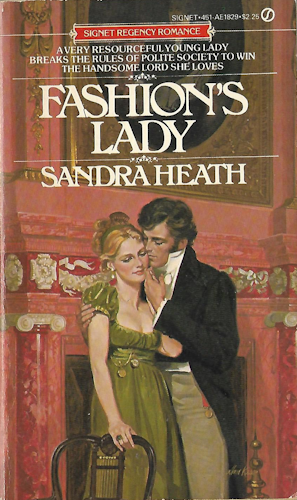
Dangerous Business

A proper young lady did not go into trade. But what was Susannah Garland to do, when she had only her dressmaking skill to keep her from the streets?

A proper young lady also did not enter into partnership with a notorious seducer like Sir Jeffrey Stratton. But what was Susannah to do, when she desperately needed his aid to open her establishment?

And, above all, a proper young lady did not listen to the wooing of another lady's husband. But what was Susannah to do, when Miles Devereux, the young lord she long had adored, asked her to help him forget his mockery of a marriage?

Susannah has to learn the price of making a profit in business - and the high cost of falling in love...


Original Publisher: Signet
Original Year of Publication: 1982
Page Count: 275

There has been an unintended hiatus to this blog, due to a long-overdue move and a lack of decent shelving to house my home library, which mostly consists of paperback novels. My vintage romance collection has been boxed up for the last 3 months, and unfortunately will continue to be for a little while longer. There is a glimmer of hope on the horizon, as bookcases are scheduled to arrive next week, albeit in pieces. But I am hopeful that I can pick up again (with regularity) by August!

The only previous experience I've had with this author is that she is not afraid to stir in some crazysauce, so I was a bit wary as I cracked this novel (newly arrived from my PBS wishlist). But, there are no wacky hijinks or forced comedic interludes here: this is straight-up trad Regency drama, which is exactly what I was looking for.

Susannah Garland is, quite literally, a poor relation. Her mother, a member of the aristocratic Devereux family, eloped with a mere schoolmaster and was basically banished from her family after that. Both of Susannah's parents died, and against her own better judgment even at 15, she accedes to her mother's wish that she return to the family fold, now headed by her mother's brother, Lord Devereux. She is not welcomed to Sanderby, the family house; everyone treats her like a stain to be covered and forgotten, except for her cousin Miles. Susannah is so overwhelmed with relief at finding a kind soul that she fancies herself in love with him, and he returns her feelings very fervently. However, Lord Devereux is a harsh taskmaster, even to his own flesh and blood. He demands that Miles make a politically advantageous match with the daughter of the family next door, or else face being thrown into debtor's prison due to his outrageous gambling losses.

Neither Miles nor Agnes, his prospective bride, want the match, but Lord Devereux is determined to have the Winston family money to refill the coffers. Miles is quite spineless and cowardly, even from the very start of the book. He pleads with Susannah to basically stay with him as his mistress after the marriage, which he will go through with because he doesn't want to go to prison. Susannah refuses, multiple times, and ultimately comes to fear for her life when she overhears a very harsh conversation between father and son. Lord Devereux threatens to banish Susannah to his Irish estates in order to keep her away from Miles; Susannah sees the writing on the wall, knowing her uncle would just as likely have her killed as anything else. She decides to run away that very night, taking her precious few possessions with her.

Luckily for her, Sir Jeffrey Stratton happens along to Sanderby at that moment, an accident befalling his vehicle. Stratton is a mortal enemy of the Devereux family, both politically and personally, but Devereux is forced to oblige Stratton a conveyance. Stratton sends his own carriage back to London (a mere 5 miles away) and Susannah slips inside it as its leaving the grounds.

She rides into London, intent on finding her father's sister in Covent Garden. She has no idea of Covent Garden's reputation, and finds herself well and truly stuck when she learns that her aunt died two years previously. Her uncle is already on the warpath, trying to find her, so she ducks into a nearby boarding house and considers her options. Miles is obviously too cowardly to defy his father, and thus won't rescue her; she has no other living family; her uncle is out for her blood. What choice does she have to to try to find respectable work?

Susannah's mother was an extremely talented seamstress, and she taught Susannah to be equally good with the needle. She's already made a few dresses for herself, and in fact uses one of these to finagle an interview at the most exclusive dressmaker's in Town, Madame Hilary. Madame acknowledges her talent, but cannot forgive her for the audacity of arriving via the front door (instead of the side). She rather reluctantly hires Susannah on for her workroom, but offers no support when her forewoman and her footman bully her relentlessly.

Susannah is quite strong, and withstands the constant torment. The other girls in the workroom are just as miserable, but nobody wants to rock the boat. Susannah is paired with another girl, Annie Jones, on her first day, and the two quickly become friends. Susannah is quite disappointed by Madame Hilary's outmoded fashions, and knows that she could do better. Annie challenges her to sketch some designs, which soon consumes all of Susannah's free time. Meanwhile, Madame picks her to run errands around Town for the shop, thanks to her refined accent and manners. Susannah knows that she is merely being used, but she doesn't care: she's starting to nurture a dream of opening her own fashion house, one to rival even Madame Hilary's. She knows exactly which clients she'd lure away, too: the ones Madame feels are beneath her notice, and for whom she gives ugly, unflattering clothes. Madame is too busy sucking up to the elites of the ton, and the royal family, to care about those considered "lesser than."

A chance encounter with Princess Amelia exposes Susannah's flair for design, and when Madame Hilary learns of Susannah's background, she blackmails her into handing over her design sketches, which of course Madame Hilary steals credit for. Suddenly she's producing new, exciting fashions and attracting even more attention than ever before. Agnes Winston even decides to have her wedding gown made by Madame's establishment, and Madame is gleeful, forcing Susannah to design the dress because she believes it will hurt her to have to stitch the very gown for the woman "stealing" Miles away from her.

Miles has discovered Susannah's whereabouts, and persuades her to meet him secretly at night. His constant whining about his untenable position, coupled with her months of working in the real world, open Susannah's eyes and makes her realize that her childish infatuation is just that. She doesn't love Miles anymore, at least not romantically, but she does pity him and his situation. She refuses (again) to be his mistress, but Miles is unrepentant. He proclaims his love for her over and over again but does exactly nothing to change his situation. He is a spineless creep and we're barely a third of the way into the book.

Susannah and the other seamstresses are given the chance to go to the church and see their work for the wedding party; against her better judgment (for she has now met Agnes and knows what a bitch she is), she decides to attend, and joins the crowd gathered outside the church to watch the wedding party arrive. She's so intent on looking at the gowns she helped make that she doesn't realize when Miles spots her in the crowd until his uncle suddenly arrives at her side and grabs her arm, threatening her to hell and back because he believes she's there to cause a scene.

She's rescued by Sir Jeffrey, who is also amongst the crowd and is curious as to why Lord Devereux is so furious with a very pretty girl. Jeffrey extracts her from the situation and they leave as the wedding party goes into the church. Susannah confesses who she is and why her uncle hates her so much, and Jeffrey is intrigued. He hates Lord Devereux and Miles just as much, and sees an opportunity to use Susannah to advance his own, quiet revenge on them. It seems Devereux's father cheated Sir Jeffrey's father out of a large amount of money, hence his grudge against them. He tells Susannah all of this, so when he offers to finance her dream of opening her own establishment, she walks into the partnership quite knowingly. Jeffrey also warns her that people will believe that she is his mistress, but being so close to her ultimate dream makes it worth the risk. Susannah agrees, and sets out to find a suitable property to open her shop.

Miles arrives not long into this process, telling Susannah that his father has died and he's now Lord Devereux. He means to set aside his marriage to the harridan Agnes and take Susannah in her stead, but Susannah refuses. She doesn't love him anymore, and besides, she's thisclose to her dream. Miles is quite ugly to her, implying that he believes she is Jeffrey's mistress, and warns her that he'll be back.

Susannah opens her shop, even when the grand showroom is destroyed on the eve of the grand opening, and suppliers around Town refuse to do business with her under threat of losing Madame Hilary's trade. Her first client is Jeffrey's (ex-) Mistress, Lady Cowper, who is sufficiently impressed with Susannah's determination in the face of disaster that she orders a gown from her and spreads the word of her shop, just as Susannah had hoped. She'd made a supreme personal sacrifice to her own pride in asking Jeffrey to ask his mistress to help; this is when she learns that they are no longer together, and though Jeffrey is invested in the financial success of Susannah's shop, he's not quite so personally invested in bringing her clients.

Susannah's shop flourishes; she hires her friend, Annie Jones, as her forewoman, and puts together a warm and inviting workroom. She attracts those who were not treated well by Madame Hilary, and soon it becomes obvious who the true designer was from the previous season. Susannah's start is on the rise, but her personal life is in shambles. She learns that Jeffrey has won the deed to Sanderby from Miles in a card game, and that Miles has deteriorated even more into his vices. Jeffrey is planning to close up Sanderby instead of letting Miles and Agnes live there. Miles continues to come round to Susannah, pleading for her to love him even though he is married and expecting a child. Susannah has fallen in love with Jeffrey, who holds her at arm's length and seems to still be in mourning for his late wife.

The years roll on; as Susannah's shop becomes the most exclusive ladies dressmaker in Town, more people are gunning for her. Miles manages to force her into a compromising situation, which leads Jeffrey to believe she's taken Miles as a covert lover; he's even more icy and cool than ever, and says some pretty awful things to her. Still, he doesn't abandon her, especially as Miles becomes more and more obsessed with her. Agnes has left him and openly taken up with a lover, so he feels entitled to do the same. Susannah still cares for Miles, but realizes the danger she's in with him. A chance for the royal warrant comes her way, and she only has to keep her reputation intact and it's hers; that's when Miles makes his final move: he demands Susannah marry him, or he will destroy her reputation as a dressmaker, leaving her with as much as she had at the beginning of the book: nothing.

The final chapter is a breathtaking climax of a scene, where everything finally comes out into the open, and Susannah is forced to make her choice. Jeffrey holds the key, in Sanderby, but no one is sure that Miles will accept anything less than the woman he's become so obsessed with.

I really enjoyed this book. I loved Susannah: she is a strong, determined, clear-minded character who knows how to get what she wants without straying into absurdity. She is quite brave in the face of a lot of nastiness and just keeps going for her goal, though what she wants more than anything is for Jeffrey to love her. Jeffrey is a suitable, if obstinate hero; Miles is a suitably disgusting jerk and it was really nice that Susannah discovers this fairly early in the book. She can't quite bring herself to hate him, not even in the end when he's threatening her livelihood and her happiness, which is more than I can say for myself, LOL.

Real historical figures are scattered throughout, and the fierce political backdrop of the early wars with Napoleon figure into the story, though not enough to distract from the romance. William Pitt, Lady Jersey, Emily Cowper, and the Prince Regent are a few figures to make cameo appearances (I thought it interesting that Ms Heath makes her hero one of the Lady Cowper's many lovers, that was pretty bold!).

I really loved this, and it makes me wish all the more that my vintage romances were readily available, as I have several of this author's backlist. Definitely recommend!

⭐⭐⭐⭐

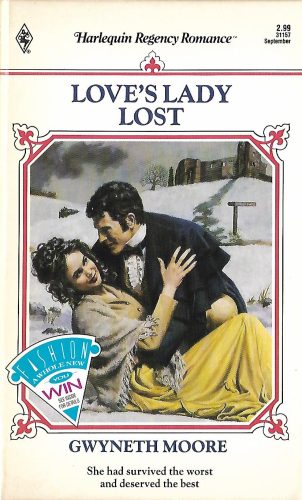
He could hardly desert a damsel-in distress

Mr Leopold Savage's rakehell reputation went before him. Thus, when he became stranded at the widow, Mrs Primrose Hythe's home, he was not surprised by her cold reception.

He was, however, surprised to be captured by a precocious six-year-old, a cantankerous cat and chicken-pox under one roof. And to find the widow becoming an agreeable, if not enchanting, companion.

Yet he never suspected her to be hiding a secret so deep and dark that even he was loath to believe it.


Original Publisher: Harlequin
Original Year of Publication: 1991
Page Count: 218

The February 2024 #TBRChallenge is "Furry Friends." I reached into my pile of Harlequin-published traditional Regency romances because I recalled having at least one with a kitty cat side character, and I came up with this.

Leopold Savage is the typical trad Regency Corinthian, footloose and fancy free, but under some pressure from his formidable grandmother to finally marry and set up a nursery. He has a falling out with his father about the same, and goes running off in the middle of a snowstorm to basically tell his grandmother to forget any clever ideas she might have about matching him up with anybody anytime soon. Because its snowing and Leo is an idiot, he breaks a wheel on his curricle in the middle of nowhere. He also spots a very young girl wandering around by herself, so he picks her up and tries to take her home. He's annoyed that she leads him not to her home, but to a nearby village, where they are both summarily shunned. A villager gives him directions to the child's home, and he realizes what's what when the front door is opened and he's greeted by a young woman covered in chicken pox spots.

The little girl, Consuela, is the child of the house; the lady at the door, Primrose Hythe, is the lady of the house in a manner of speaking. She runs a modest little boarding house with one ancient maid and scatterbrained young cousin just down from Oxford. Mercifully, Leopold has already had the chicken pox, so he's okay to stay at this curiously dilapidated house with quite a few objects d'art littered about.

Leo makes himself right at home, especially endearing himself to Consuela when he agrees to bathe Milor', the big black Persian cat who considers himself lord and master. This goes about as well as can be expected; Milor runs off in the wake of the insult and is nowhere to be found. By this time, one of Leo's BFFs has arrived to tell him that not only is his grandmother not at her residence, but she's planned a huge ball in his honor and is prepared to basically auction him off to the highest bidder in the matrimonial stakes. Leo can't have that, so he comes up with a plan to use the "notorious" widow Hythe to basically scare away all comers.

This was an odd read. While competently written (tightly plotted and amusing in the comedy-of-manners way of a trad Regency), I didn't really connect with the characters. The main POV is Leo Savage, but even his motives are opaque when he goes from being the kindhearted funny house guest to a cold, arrogant jerk at the idea of being a matrimonial target by his grandmother. It doesn't help that he constantly calls Primrose "The Spotted Hythe" as a term of endearment, even after the chicken pox fade. When he hears Primrose's deep dark secret (that Consuela is not, in fact, her daughter but her niece, born from a false elopement between her sister and the nefarious Conrad Furness, who only "married"/trapped Primrose's sister because Primrose herself had the audacity to turn him down; Primrose is terrified that Furness will learn the truth of Consuela's parentage and use her to take the family home to restore his own coffers), he basically tells her that he doesn't believe her, but blackmails her into being his "date" for his grandmother's ball by promising to keep schtum if she does so. Her reputation will piss off his family, which he considers a win somehow. Then, at the ball, he treats her abominably and lets those attending do the same, making sure that her reputation is known far and wide and that she's ostracized for it. He's doing this in a plot to "trap" Furness and disgrace him, but does he tell Primrose that? No, he just goes on being cruel to her, explaining afterwards that he had to do it to ensure she had an honest reaction, to make it all the more believable for their audience at the ball and then later during Furness's comeuppance.

It was needlessly cruel, and not until it unfolds on the page do we know what Savage is doing, and why. This is a romance novel?? Ugh.

Primrose is similarly dull, and Consuela is a completely unbelievable child (who apparently has no grasp of personal pronouns whatsoever, which made the dialogue hard to read). Unfortunately even the cat is gone for a large chunk of the book, presumed dead and replaced with a pair of clucking hens, all so that Savage and his BFF can hilariously try their hand at building a henhouse. At least everyone gets a good laugh out of that, before everything turns sour. (The cat does return at the end, and actually takes up residence in the ridiculous henhouse.)

This was not a good read, and it's going on my PBS pile. It is apparently the third in a series by this author, but the wild way this one went pretty much completely put me off trying anything else by her.

⭐ 1/2

Memories...

Tye Hatcher returned to Aspen Grove to find that life in the sleepy Western town hadn't changed much. The townspeople stubbornly refused to see the man he had become. That is, everybody but Meg Telford. Meg definitely took notice of the reticent rancher and gave him a change in life when no one else would. Still, Meg clung to the memories of her late husband, afraid of the feelings Tye aroused in her heart. And though Tye vowed to prove his worth to the town, could he ever prove to Meg that he was worthy of her love?


Original Publisher: Harlequin
Original Year of Publication: 1999
Page Count: 299

The January 2024 #TBRChallenge is "Once More with Feeling." I chose to interpret this as a second chance romance prompt, and dug into my Harlequin Historicals for a tried-and-true favorite author. I tend to hoard their backlists for when I especially need a strong read, and what better way to start this year's reading challenge than with a Cheryl St John title?

As the blurb implies, our leads have baggage galore. Tye Hatcher has returned to Aspen Grove, Colorado, after the Civil War. He's not sure why he returned to the town, given the fact that he's been ostracized practically since birth. His mother was a saloon girl and his father didn't even acknowledge his existence. He's always been on the outside looking in, and I guess he figured one place was as good as any to return after war. He's trying to save up some money to buy some land to start a rendering plant, but thus far has had no luck seeking gainful employment. The only place that will have him is the local saloon, where he plays the piano in the evenings.

Meg Telford is a beautiful young woman who was a town favorite even before marrying into the prosperous Telford family. Her husband, Joe, did not return alive from the war, and she's been in mourning ever since. She's at a crossroads: she and Joe bought a plot of land and a bunch of cattle before the war, trying to make it on their own as ranchers. Joe barely had time to build a house before being called for the war effort, and now Meg is down to her last dimes trying to keep hold of her land. Her husband's family is pressuring her to sell and move in with her mother-in-law, Edwina. Edwina has made mourning a Way of Life: first she donned the black for her own husband, and then for her beloved son, Joe. She wants Meg to move in with her and basically serve as a companion, but Meg wants desperately to hold onto Joe's dream of the ranch.

To that end, she comes to a conclusion: she needs a man to work the land and coax a profit. She can't afford to pay him, so she decides to offer a marriage of convenience instead. The only eligible man in town is Tye Hatcher, whom Meg knew as a child. Meg is perhaps the only respectable person in town willing to give Tye a chance, aside from the Reverend. She thinks long and hard and decides to offer marriage - and her property - to him. It will save her from having to sell the rest of her furniture to pay the mortgage and will get Edwina & co off her back about selling.

Meanwhile, Tye has been approached by an old friend, Lottie, who is dying and wants him to take guardianship of her young daughter, Eve. Lottie plays on Tye's emotions to achieve this end, knowing how strongly he feels about being a fatherless child, and wanting to shield an innocent from such a fate. He agrees to take Eve, even though he can barely support himself, much less a child.

Meg's proposal comes just in time. Tye is shocked, and warns her that if he marries her, she will also be ostracized by the town. Meg is desperate enough to not care. They agree to marry, and Tye will move onto Meg's ranch. With her land and her stock, the rendering plant will be even more successful, even sooner - if they can make it through the season and keep the cattle alive long enough to be sold.

Meg doesn't quite believe Tye about the town turning their backs on her, but she gets a taste of it firsthand at their wedding, when nobody attends except her farm hands (her sister-in-law sneaks in, too, behind her husband's back, but only for a very short period). Meg is shocked, but swallows her pride and moves forward. She's struck her bargain and she's going to stick with it.

The dead husband, Joe, is a huge wedge between them. Meg loved him dearly and is not quite ready to let his memory go. Tye is jealous of this, and because Joe kept providing for her even beyond the grave: he sent home a pair of exquisite horses that Tye decides to stud out, covering some of their immediate monetary needs. Joe also built Meg a house and started the ranch, and Tye wonders how he could ever take his "rightful" place on the ranch that's now his.

Lottie dies soon after Tye and Meg wed, and Tye is forced to tell Meg about Eve. Meg balks at taking in a whore's illegitimate daughter, but Tye insists and brings Eve to the ranch. Meg softens towards the child, but becomes jealous of the bond that Tye and Eve forge. She fights with herself about her feelings, her memories, and her own pride, especially when she sees how shabbily the rest of the townspeople treat Eve.

There's a LOT of baggage to go around, and a lot of things that could've been solved if Tye and Meg had bothered talking to each other instead of making assumptions. Once they do being talking, tensions ease, at least between them. They decide to adopt Eve, legitimizing her and taking away the stigma that Tye labored under as a kid. They have a successful breeding season with the cattle and the horses. Tye even manages to buy back the ring that Meg had to sell at the beginning of their marriage to cover a mortgage payment, even though he does it in secret by returning to town to play nights in the saloon, leaving Meg to think the worst.

There's a lot to sink your teeth into, and a lot to mull over. Tye and Meg both deal with feelings of insecurity, jealousy, pride, shame, and humiliation. The author pulls no punches at how awfully the town (and Meg's family, led by Edwina) treat them all, even little Eve. There is an excellent moment of catharsis when Meg confronts her former mother-in-law about the terrible things she's saying about Meg and how Joe WOULD NEVER if he was still alive.

For all the awesome, there is some "meh" as well. Meg's absolute lack of knowledge of the marriage bed was unbelievable, considering she was happily married. She didn't know sex was supposed to be fun?! WTF?? Their own pleasure was basically the only thing women in 1865 had to call their own and no one else's, but Meg spends most of the book feeling ashamed for how lusty she feels over Tye, her own husband. (Yeah, okay.) She also apparently didn't know anything about the signs and symptoms of pregnancy. I just can't buy that a woman who is otherwise intelligent has absolutely no knowledge of her own body.

It is also disappointing that Tye has to make a Grand Gesture at the end to be accepted by the town, much less Edwina and the rest of the Telfords. Grand Gestures are some of my least favorite plot devices, and I kinda wanted them to keep forging their own way and to hell with those who were prejudiced against them. But, that's me. Obviously Tye proves his worth to the town, and to his wife, and they all live happily ever after.

It's another strong showing by Ms St John, and another great, meaty Western historical that hits all the feels. It was a great book to start this challenge with, and gives me hope for the rest of the prompts!

⭐⭐⭐1/2

I've taken part in the #TBRChallenge for the last couple of years and really enjoyed it! If you'd like to play along, the information is here.

This year's prompts are going to be pretty challenging. I might have to plan more than I currently do (frantically choosing something the weekend before the challenge is due, LOL).

Happy reading!

Life held little joy for Celia Murray. Forced by poverty to leave her aunt, who had been her only source of love and warmth, Celia goes to the city to find a job. There she tries to make the best of her new home: a dreary boarding house.

Then everything changes! Celia receives an unexpected inheritance and so sets about to make her dreams come true. She sends for her Aunt Hannah, and together they work a miraculous transformation on the old boarding house, making it into a place of warmth and laughter. Yet Celia struggles with a sense that there is something - or someone - missing.

Enter handsome Horace Stafford, minister of the mission chapel. At first Celia believes this is a man whose faith and compassion matches her own. But when a terrible misunderstanding comes between them, will Celia ever be able to confess, even to Horace, the deepest desire of her heart?


Original Publisher: The American Sunday School Union
Original Year of Publication: 1900 [1993 reprint]
Page Count: 246


Celia Murray is a lonely young lady in the big city of Philadelphia, who works at a ribbon counter and lives in a cheap boardinghouse. She'd love nothing more to than to bring her aunt Hannah to live with her. Hannah had raised her after her own parents' death, and is now stuck with Celia's ungrateful cousin Nettie, her husband, and her bratty kids out in the suburbs. Celia discovers that she is the heir of a family legacy from her late father's great uncle, which will give her enough income to buy the boardinghouse that she's living in and bring her aunt Hannah out to run it. Together, they plan on starting a little mission in the heart of the city: they'll fix up the boardinghouse, give the boarders decent meals and a nice place to live, and will encourage them to find religion. Their cause is greatly helped when one of the first new boarders to arrive is Horace Stafford, a missionary minister who's planting a new church nearby.

Aunt Hannah reminded me strongly of Aunt Crete. She's a kindly woman who has been sorely tried and tested by ungrateful relatives for most of her life. Hannah had planned to become a missionary as a young woman, with her theology student fiancé, before said fiancé's tragic death after he graduated from seminary. Once upon a time she wanted to go and save foreign heathens; she's delighted by the idea of having the chance to save some native heathens instead. She jumps in with two feet to make over the boardinghouse and minister to the boarders, of whom she grows quite fond.

Celia, on the other hand, basically falls at the first hurdle. She can talk the talk but she fails quite miserably at walking the walk. One of the boarders comes home drunk one night, and she's so horrified and afraid that she roundly ignores him, a young man she'd previously been quite friendly with. She overhears Horace talking to him and is unhappy that they are laughing together - Celia believes he should be preaching at him about his sins. Aunt Hannah tries to interest Celia in helping another of their boarders, a very young girl who works in a three-cent store and seems to admire Celia, but Celia is disdainful of her (the girl asks for beauty tips, how dare she!) and more or less only grudgingly assists her, all the time whining about how this is no way to bring new souls over to God. Aunt Hannah tries to explain that God works in mysterious ways, but for most of the book, Celia is having none of that.

She also makes a complete cake of herself, because she finds a picture of a beautiful young woman in Horace Stafford's room and immediately assumes that this is his sweetheart, so she acts cold and distant around him even though she's in love with him. When one of the boarders tells her that it'd be nice if they got married, Celia gets actively angry at the idea. Of course, the girl in the picture is not Horace's sweetheart, and Celia - quite rightly! - feels like a complete idiot when she learns the truth.

The boarders are a found family, and I enjoyed the parts of the story about fixing up the boardinghouse. I really liked aunt Hannah; if she had been the main character instead of Celia, my rating would've been higher. There are strands of romance, mostly blink-and-you'll-miss-them, but what's there is sweet.

This was originally published in 1900 by the American Sunday School Union, which should tell you all you need to know, LOL. This is one of GLH's earliest works and oof, does it show. It's almost written like fanfic, with long quoted passages of verses, songs, poems, etc. There's even a note at the beginning from GLH's daughter, warning readers that it's an early work and that her mother hadn't yet "developed her mature writing style" o.O I'd say that this one is for GLH completionists only.

⭐⭐