![[personal profile]](https://www.dreamwidth.org/img/silk/identity/user.png) vintageromancereader
vintageromancereader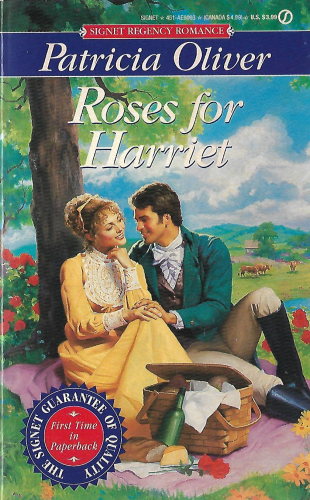
An immodest proposal...
Lady Harriet Egerton had reason to be shocked when the devastatingly handsome Earl of Kimbalton, Giles Montague, asked her to wed. He frankly admitted that love played no part in his proposal. All he wanted of her was the good sense to leave him free to pursue pleasure beyond the marriage bed.
On the other hand, Harriet had good reason to say yes. The wealthy lord promised her the means to cultivate her passion for peace, quiet, and horticultural perfection. Even better, he assured her that she need not fear his amorous attentions. But could Harriet trust the pledge of a man who thought nothing of breaking a marriage vow? And even worse, once she was on the garden path of temptation, could she trust herself?
Original Publisher: Signet
Original Year of Publication: 1995
Page Count: 220
The April 2021 #TBRChallenge theme is “old school.” This is right in my wheelhouse as a vintage romance reader, and I plucked this book from my collection because I was intrigued by the idea of a gardening heroine.
Giles Montague has a problem. His older brother has died, leaving him (the spare) to inherit the family title. As the new Earl of Kimbalton, it’s on him to do his duty and find a wife so he can sire his own heir and spare to continue to familial line. His mother would be only too happy to “assist” in this process, especially now that he’s returned home from his diplomatic post in Paris. Knowing that Lady Kimbalton’s idea of a future countess is some simpering miss straight out of the schoolroom, Giles is determined to cut his mother off at the pass. If he can somehow find himself married before he returns to London, that will put an end to his matchmaking mama’s ambitions. He knows what he wants, too: a not-too-young, not-too-stupid, not-too-pretty woman who is content to live at his country seat in Hampshire and leave him be to continue his bachelor existence (that is, to continue seeing his current mistress of four years that he’s housed in London for this express purpose). He doesn’t want to have to see her or deal with her in close proximity, beyond the machinations to produce an heir.
His BFF, Peter Egerton, Viscount Bridgeport, has the perfect candidate: his twenty-six-year-old spinster sister, Harriet. She had one disappointing Season in London at 18 but has otherwise remained in the country, having lately inherited her own small property, Lark Manor, from a grandmother. She spends her days quite happily tending her roses and serving as a companion to her elderly aunt. Who better to keep tucked away on a country estate that such a creature?
What makes a marriage of convenience story work is when both characters walk into it knowing the truth of their situation, and when they each consider themselves to be getting something out of the bargain, besides the protection of marriage/title/wealth. It’s obvious how this arrangement would suit Giles, but what of Harriet? She is not exactly jumping for joy at the idea of getting married, even if it is to her older brother’s BFF, and she continually asks Giles what’s in it for her? After all, she’s an independent woman with her own property, income, and suitors. Why should she give all that up to become his countess?
Unfortunately, Harriet capitulates when Giles tells her he needs her. Really? A woman with all of those advantages is willing to chuck it all because some man she barely knows tells her he ‘needs’ her? I hate that. I’m not a reader who enjoys a heroine (or hero, for that matter) who likes taking in strays and ‘fixing’ them. Come into a partnership as equals, as much as is possible, or else have gross power dynamics from the very start ☹
So Harriet (and her aunt) move into Kimbalton Abbey, and Giles toddles off to London to resume his previous life. Harriet sets about transforming the cold, unwelcoming building, starting with planting tons of her rose bushes in the 400-year-old property. They are effectively leading separate lives, and all is well and good. Matters first come to a head at Christmas. Harriet has no idea if Giles is returning to his estate or not, so she decides to return to Lark Manor for a Christmas with her family and friends. Giles is None Too Pleased when he does indeed return to the Abbey to find his wife is gone, and has to traipse around to her property to find her. He’s terribly jealous of one of her former suitors, intimidated by his masculine beauty, and basically acts like an ass at her big Christmas ball. She lashes out at him and makes a scene, then quails at the idea that he’ll beat her for it. At this point I’m just sort of rolling my eyes, because it seems the author can’t decide if Harriet is going to be an outspoken independent woman or the wife of a stuffed-shirt earl. I understand Harriet’s wishy-washiness about being a good wife and countess, but I don’t understand her sudden desire for this stranger who insults her regularly and spends most of his time ignoring her. She takes his harsh words to heart, and experiences the whole ‘body betraying her’ business 🙄 🙄 🙄 that old school romances are so fond of having their virginal heroines experience. (They are virgins, therefore they are completely ignorant, and of course only desire men who reject them.)
There is some odd stuff here about Giles experiencing impotence when Harriet accuses him of treating her like a whore, thanks to some truly cringeworthy attempts at seduction on Christmas Eve, which carries on through the story, even after he rushes back to London to be at the side of his sick mistress (of whom Harriet is of course ragingly jealous, because this worldly and experienced woman satisfies her husband sexually, which she herself has no idea how to do). Its just as magically cured later on, with no apparent consequences.
Matters are further complicated when Giles’s bastard brother Richard shows up at the Abbey after being invalided out of the army. He hates Richard for being his father’s by-blow AND because Richard hero-worshipped him as a child (after all, cuckoos aren’t supposed to be introduced into the familial nest and treated as equals to the legitimate sons). He becomes ragingly jealous over the idea of Richard being at his ancestral home with Harriet, too, thinking the worst of all of them because once he receives word, he rushes back to the Abbey to confront them about possibly having an affair.
The book takes a strangely light-hearted turn here, as Richard turns out to be good-natured (albeit bitter about the way Giles treats him), and happily squires Harriet about in Giles’s absence. Harriet and her aunt go to London to tend to a sick relative, and runs into an old friend at a bookshop – the woman who just happens to be Giles’s mistress! Harriet is determined to take up their old friendship as if nothing has changed in the ensuing years, and as if they aren’t basically sharing a man. Her jealousy over Giles’s mysterious lady love somehow softens when she learns that it’s a dear old schoolmate, and she even brings her back to the Abbey to nurse her to better health…and then wonders why Giles doesn’t return with them. 🙄
Perhaps the most disturbing undercurrent of all of this is the position of Peter, Harriet’s brother and Giles’s BFF. He not only introduced the two of them, but also introduced Giles to his mistress, who was Harriet’s school chum. If Peter and Harriet as are close as we’re meant to believe, how did Peter not know who Harriet’s friends where?? How could he in good conscience offer up his sister to marry a man who’s bedding her BFF on the regular?? And its all just swept away as if it’s nothing, part of the same light-hearted romp where a wife and a mistress can be BFFs without issues just because they were BFFs as children. It definitely struck a strange note.
Giles makes all of these concessions in life, stumbling out of his lifelong straitjacket of tradition, but continues to take out his frustration on Harriet, who basically just whimpers and runs to her aunt for comfort. These two never really communicate or seem to develop anything other than jealous, lustful possessiveness of each other. It was tiresome to read about. I pretty much had to read this book in one sitting, because I knew if I put it down, I’d never pick it back up again.
Harriet’s titular roses are basically a D-story to all the melodrama, and she spends very little of her time cultivating them, when its supposed to be her major hobby and source of happiness. I don’t understand how or why she falls in love with Giles, or vice versa. I found her rejected suitor to be a far more interesting character. He’s disparaged as “a mere boy” and held in contempt for actually showing his warm regard towards her. Personally, I find it incredibly juvenile when people snipe and fight constantly, and this behavior is then held up as the ultimate expression of love. Give me a break!
This story had promise, but the execution was uneven at best, and a total disappointment at worst. I don’t think I’ll read more of this author’s work.
⭐⭐


